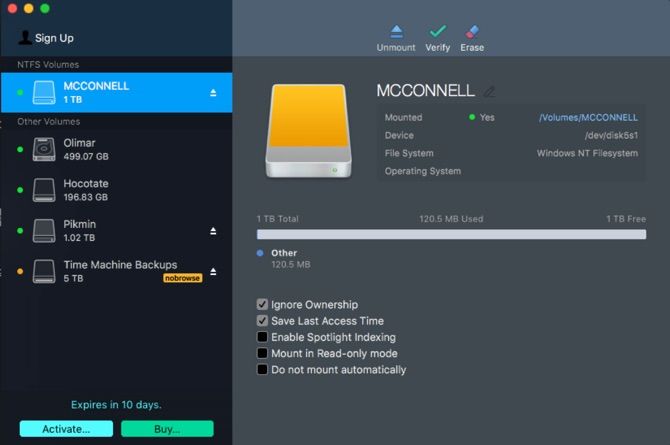
'Is it possible to format FAT32 and NTFS drives on Mac by myself?' A user asked us about this question. Part 1: Format FAT32 Drive on Mac First, let us look on how to format FAT32 drive on Mac (macOS Sierra). You could be wondering what FAT32 is. It is a file system in Windows 95, 98, and windows Millennium Edition. Microsoft NTFS for Mac by Paragon Software is a great upgrade to an exceptional cross-platform utility that’s easily worth the money, especially if you own the previous version 14, in which case this one’s free.
Summary
For Apple Mac users, there are two ways to format USB flash drive to FAT32, including Disk Utility and Terminal command line. Refer to detailed steps of using both tools for FAT32 format. Formatting would erase data completely, make sure that you have a data backup. Otherwise, you can only use data recovery software to recover data from a formatted USB drive.
How to Format a USB Flash Drive with Mac to FAT32
Many computer users who use a removable flash drive have the demand for formatting it to the FAT32 file system. Compare with the other commonly used NTFS file system on a flash drive, FAT32 has a compatibility advantage across many operating systems.
It's a universal format that is compatible with Mac OS X/macOS, Windows, Linux and DOS systems. So, if users anticipate using the flash drive with more than one operating system, they will definitely benefit from the FAT32 file system. For Apple Mac users, there are two ways to format a USB flash drive to FAT32, including Disk Utility and Terminal command line. Refer to detailed steps of using both tools for FAT32 format.
Method 1. Format FAT32 on Mac [Disk Utility]
To format USB to FAT32 with Disk Utility will erase all data on the flash drive, so before you doing so, please do remember to check whether you have saved useful data to another secure device in advance.
To format the USB drive to FAT32, follow the next steps:
Step 1. Connect the USB flash drive to your Mac computer.
Step 2.Go to Applications > Utilities > Double click and open Disk Utility.
Step 3. Select your USB flash drive on the sidebar, choose Erase.
Step 4. Rename the USB flash drive, choose the format as MS-DOS (FAT) for Format, Master Boot Record for Scheme. Then click Erase.
Wait for the process to complete, then you’ll get an empty new USB flash drive with FAT32 as the file system. You can reuse it for saving data again.
Method 2. Format FAT32 on Mac [Terminal Command Line]
The command line behavior does the same way to erase data with the Disk Utility. Again, create a backup before taking this action.
To format FAT32 with Terminal, follow the next steps:
Step 1. Connect your USB flash drive to your Mac computer.
Step 2. Hit cmd + space to run Spotlight, type: terminal and hit Enter.
3. Type:diskutil list and find out which disk is your USB drive. (In the below picture, you can see that /dev/disk2 is the USB drive)
4. Type: sudo diskutil eraseDisk FAT32 MBRFormat /dev/disk2.
- sudo gives you user right.
- Diskutil calls disk utility program.
- eraseDisk commands to format.
- FAT32 sets the file system.
- MBRFormat tells disk utility to format with a Master Boot Record.
- /dev/disk2 is the location of the USB drive.
Wait for the process to complete. After this, you can type: diskutil list in command again to check if the formatting has been successful.
Complementary Data Recovery Tip
Formatting would erase data completely, make sure that you have a data backup. Otherwise, you can only use data recovery software to recover data from a formatted USB drive.
EaseUS Data Recovery Wizard has both Windows and Mac versions, so it's the optimal choice for data recovery, no matter you're using a PC or Mac. If you're a Mac user, for example, it takes only a few clicks for the software to scan and display your formatted data. To guarantee an effective data recovery without spending money to no avail, you can install the Mac data recovery free version for the first trial. You can preview all the found data before the final recovery.
To recover data from a formatted FAT32 USB flash drive on Mac, follow the next steps:
Step 1. Correctly connect your USB flash drive to your Mac. Launch EaseUS Data Recovery Wizard for Mac. Start selecting the flash drive and click Scan to let the software search lost files on it.
Step 2. After quick scan and deep scan, all files will be presented in the left pane in the scan results.
Step 3. Select files you want to recover and click Recover Now button. Don't save the recoverable files to the USB drive itself in case of data overwriting.
Looking to share an external hard drive between a Mac and PC? The best way to do it is with a drive formatted as FAT32. Though this format has some limitations, it enjoys nearly universal support from active platforms, including Mac and Windows operating systems, and many gaming and Linux OSs.
The chief drawbacks of FAT32 involve file and partition size limitations. FAT32 imposes a size limit of 4GB on single files. So if you work with bulky video clips, for example, adopting FAT32 may not be a good idea. When formatting partitions, Windows 7's Disk Management utility won't let you create one that's larger than 32GB, whereas Mac OS X Lion can create partitions as large as 2TB using its Disk Utility application. Finally, Mac OS X's Time Machine backup utility won't work with FAT32.
Windows prefers to use NTFS (which stands for New Technology File System, though it has been around for nearly 20 years now). Macs running Snow Leopard or Lion can read from drives formatted as NTFS, but they can't write to such drives unless you install a third-party driver or muck about in the Terminal. Conversely, Windows 7 can't read and write to drives formatted as HFS+--also known as Mac OS Extended (journaled)--unless you install third-party software such as Paragon's.
Formatting From a Mac
To format a drive as FAT32 from a Mac, follow these simple steps.
1. Set up your drive following the manufacturer's instructions. Connect the power supply (if necessary), connect to the Mac via USB or FireWire, and turn on the drive. The drive should automatically mount on your Mac's desktop (if the finder preferences are set to show external drives). If the drive is not formatted, you may get a message saying that the drive is unreadable by Mac OS X and asking you whether you want to format it via Disk Utility. We're going to do this anyway, so open Disk Utility from the prompt or by navigating to /Applications/Utilities.
2. Mac OS X won't let you create a FAT32 partition larger than 2TB; so if your drive is larger than that, you'll need to divide the available drive capacity into multiple partitions. You can format the remaining space as a second FAT32 partition or as an HFS+ partition, or you can leave it as unallocated space. To create a new partition, click the drive in the list on the left side of the Disk Utility menu. Click the Partition button in Disk Utility's main window. By default, Mac OS X will use the GUID partition table to format the drive. You can use this and still share FAT32 volumes with a PC, but if you'll primarily be using the drive with Windows, and if the full capacity of the drive doesn't exceed 2TB, the wiser course is to wipe the drive and then use Windows' Master Boot Record (MBR) partition scheme.
3. Click the Partition Layout drop-down menu in Disk Utility, and select the number of partitions you want to create. By default, Disk Utility will divide the available space in half. You can resize the partitions by clicking the line between the partitions and dragging it up or down to increase or decrease the capacity of one or the other side.
4. Click on whichever partition segment you want to format as FAT32. Type a name for that partition in the Name field and choose the FAT32 option from the Format drop-down menu. Once everything is arranged as you want it, click apply. A progress bar will appear at the bottom right of the window as Disk Utility creates the requested partitions. Once it finishes creating them, you can move the drive between Macs and Windows PCs, and move files back and forth easily.
Formatting From a PC
Here's how to create a FAT32 partition from a Windows 7 PC.
1. Open the Disk Management utility. To do so, select Start, Control Panel, System and Security, Create and format hard disk partitions. Alternatively, press the Start button and start typing partitions.
2. Find the drive you'd like to format; in my case, it was Disk 5. Click the disk number, and select Convert to MBR Disk ('MBR' stands for 'Master Boot Record'). Right-click the unallocated segment in the next field over, select New Simple Volume, and click Next when the wizard launches. Change the value in the Simple Volume size field to 32,768MB or less--it needs to be under 32GB, to satisfy the format's file limit. Assign a drive letter, and click Next.
Fat32 Mac And Pc
3. Choose the drive letter to be assigned and click Next. Select FAT32 from the File System drop down menu, label the volume however you like, check the box next to Perform a quick format, and click Next. The resulting window tells you that you have successfully completed creating the volume. Click Finish and you're ready to go.