Adobe® Acrobat® Reader® DC is free software you can use to read and access the information contained within PDF files. Adobe Acrobat Reader DC contains many capabilities specifically designed to make it easier for people with disabilities to read PDF files, regardless of whether the files have been optimized for accessibility. VoiceOver is the screen reader included with Mac OS X. This tutorial covers how to use the keyboard to navigate to the Universal Access preferences, where the accessibility settings for Mac OS X are found, while the screen reader is active.


Edit a video without using a mouse or trackpad. Build a presentation without seeing the screen. Or track down important files for your next project with just your voice. Because Mac is designed for everybody to create amazing things.
VoiceOverYou don’t need to see your Mac to use your Mac.
VoiceOver is a revolutionary built-in screen reader that’s more than a text-to-speech tool. It tells you exactly what’s on your screen and talks you through actions like editing a video, building a presentation, or quickly navigating from one app to another.
Dark ModeWorking hard gets easier on the eyes.
Dark Mode transforms the desktop and built-in apps with a new dark color scheme that helps you focus on your work.1 The fine points of your content take center screen as toolbars and menus recede into the background. Light text against darker backdrops in Mail, Safari Reader, Calendar, and more makes everything easier to read in low lighting conditions. And the Accessibility preferences for increased contrast and reduced transparency work with Dark Mode enabled.
SiriMake requests by talking or typing.
Siri on Mac lets you quickly find and open files, set reminders, send text messages, and more, making it easy to handle the things you do every day.2 With “Type to Siri” mode, you can make requests using a physical or onscreen keyboard. And Siri can also predict your next word based on what you’ve said before, so you can minimize typing over time.
Switch ControlNavigate your Mac with as little as a tap.
Create amazing things with your Mac without touching a mouse or keyboard. With Switch Control, you can navigate through onscreen keyboards, menus, and the Dock using a variety of switch options.
Text to SpeechGo from written word to spoken word.
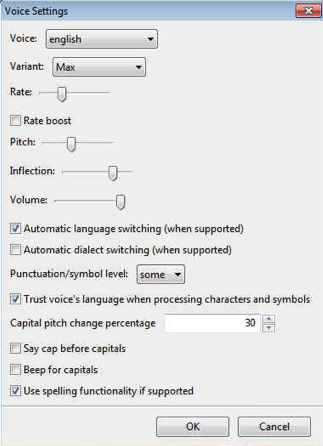
If you learn better when you can hear what you’re reading or writing, Text to Speech lets you highlight any text and have your Mac read it aloud. And you can choose from more than 70 male or female voices across 42 languages.
Control accessibility options with your keyboard and Siri
You can use the keyboard shortcuts below to control accessibility options on your Mac, or you can ask Siri to perform these functions. For example, ask Siri to 'Turn VoiceOver On.'
| Action | Shortcut |
|---|---|
| Display Accessibility Options | Option-Command-F5 or triple-press Touch ID (power button) on supported models1 |
| Turn VoiceOver on or off2 | Command-F5 or Fn-Command-F5 or hold Command and triple-press Touch ID on supported models1 |
| Open VoiceOver Utility, if VoiceOver is turned on2 | Control-Option-F8 or Fn-Control-Option-F8 |
| Turn zoom on or off3 | Option-Command-8 |
| Zoom in3 | Option-Command-Plus Sign (+) |
| Zoom out3 | Option-Command-Minus Sign (-) |
| Turn the Invert colors setting on or off | Control-Option-Command-8 |
| Reduce contrast | Control-Option-Command-Comma (,) |
| Increase contrast | Control-Option-Command-Period (.) |
Screen Reader Accessibility Testing
- MacBook Pro (15-inch, Late 2016), MacBook Pro (13-inch, Late 2016, Four Thunderbolt 3 Ports)
- To use VoiceOver and VoiceOver Utility, you might need to turn on 'Use all F1, F2, etc. keys as standard function keys' in Keyboard preferences. You might also need to make VoiceOver ignore the next key press before you can use some of the other Mac keyboard shortcuts.
- To use the zoom shortcuts, you might need to turn on 'Use keyboard shortcuts to zoom' in Accessibility preferences.
Use your keyboard like a mouse with Full Keyboard Access
Full Keyboard Access lets you use your keyboard like a mouse to navigate and interact with items on the screen. With Full Keyboard Access, you use the Tab key and arrow keys to navigate to items on the screen, and the Space bar to select an item.
Screen Reader For Mac
Follow these steps to turn on Full Keyboard Access:
E-reader For Mac
- Choose Apple menu > System Preferences, then click Keyboard.
- Click Shortcuts.
- To navigate only to text boxes and lists on the screen, select 'Text boxes and lists only.' To enable Full Keyboard Access and navigate to all controls on the screen, select 'All controls.'
| Action | Shortcut |
|---|---|
| Switch between navigation of all controls on the screen, or only text boxes and lists | Control-F7 |
| Move to the next control | Tab |
| Move to the previous control | Shift-Tab |
| Move to the next control when a text field is selected | Control-Tab |
| Move the focus to the previous grouping of controls | Control-Shift-Tab |
| Move to the adjacent item in a list, tab group, or menu Move sliders and adjusters (Up Arrow to increase values, Down Arrow to decrease values) | Arrow keys |
| Move to a control adjacent to the text field | Control–Arrow keys |
| Choose the selected menu item | Space bar |
| Click the default button or perform the default action | Return or Enter |
| Click the Cancel button or close a menu without choosing an item | Esc |
| Move the focus to the previous panel | Control-Shift-F6 |
| Move to the status menu in the menu bar | Control-F8 |
| Activate the next open window in the front app | Command-Accent (`) |
| Activate the previous open window in the front app | Shift-Command-Accent (`) |
| Move the focus to the window drawer | Option-Command-Accent (`) |
Navigate menus with your keyboard
To use these shortcuts, first press Control-F2 to put the focus on the menu bar.
| Action | Shortcut |
|---|---|
| Move from menu to menu | Left Arrow, Right Arrow |
| Open a selected menu | Return |
| Move to menu items in the selected menu | Up Arrow, Down Arrow |
| Jump to a menu item in the selected menu | Type the menu item's name |
| Choose the selected menu item | Return |
Use Mouse Keys to move the mouse pointer
When Mouse Keys is turned on, you can use the keyboard or numeric keypad keys to move the mouse pointer.
Mac Accessibility Shortcuts
| Action | Shortcut |
|---|---|
| Move up | 8 or numeric keypad 8 |
| Move down | K or numeric keypad 2 |
| Move left | U or numeric keypad 4 |
| Move right | O or numeric keypad 6 |
| Move diagonally down and to the left | J or numeric keypad 1 |
| Move diagonally down and to the right | L or numeric keypad 3 |
| Move diagonally up and to the left | 7 or numeric keypad 7 |
| Move diagonally up and to the right | 9 or numeric keypad 9 |
| Press the mouse button | I or numeric keypad 5 |
| Hold the mouse button | M or numeric keypad 0 |
| Release the mouse button | . (period) |
Learn more
- Change the behavior of the function keys or the Caps Lock, Control, Option, and Command keys
- Ask Siri to perform some of these commands, or ask Siri 'What can you do?' to find out more